
30 Jun Nature’s Pollinators | June 2026
Meet Nature’s Pollinators
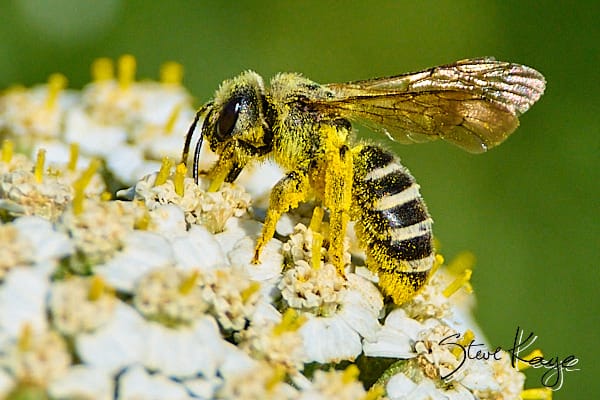
Bee, Genus Halictus – Notice that this bee is covered with pollen.
> There are more than 200 species of this genus. Thus an exact identification can be difficult. And this bee refused to go into a lab for a DNA test.
Every day, Nature’s pollinators go to work.
They pollinate flowers, and in turn, they help make the food we eat.
These essential, hard workers include bees – Plus butterflies, hummingbirds, moths, and wasps.
Let’s visit a few of the bees.
When you find one, say, “Thank you” for the important work they do.
Then spend a mindful moment watching them.
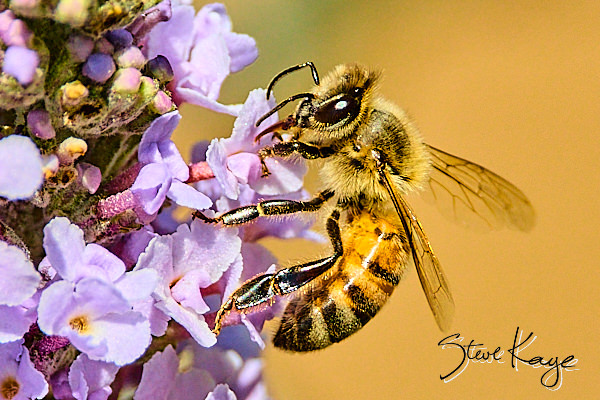
Western Honey Bee
> Notice the hair on its eyes.
Notice how they move and how they work.
And then notice details. For example, bees are covered with hair. And the Western Honey Bee even has hair on its eyes.
This might explain why these bees never wear glasses.
By the way, in June we celebrate National Pollinators Month. There is also a Pollinators Week during June 22 – 28, 2026.
So mark your calendars.
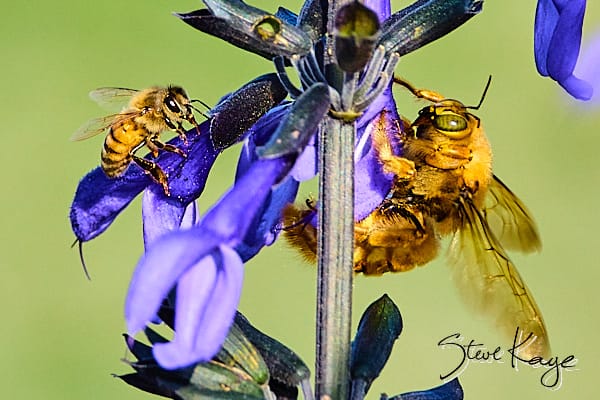
Western Honey Bee (Left) and Valley Carpenter Bee, Male (Right).
> The female Carpenter Bee is black with black eyes.
Now, in the spirit of enjoying pollinators, here is a story.
A man came to our house and asked, “Are you interested in pest control?”
And I said, “Yes!”
He smiled.
“But first, these are my friends, not pests.”
His expression changed to curious.
Then I said, “I do need help with control. Can you make them they land on flowers near me? In bright light?
And can you make them pose for interesting photos?”
Now he frowned. “But what about pests in your house?”
“Oh,” I replied, “I put up signs telling them to stay out.”
He left.
Quickly.
And maybe he put me on their “Do Not Visit” list.
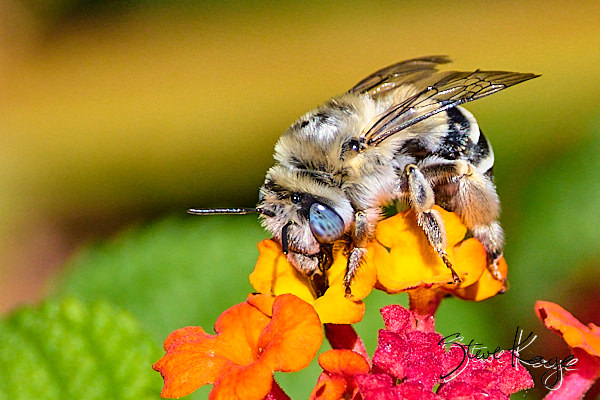
Digger Bee
> Some bees have amazing, beautiful eyes.
You can help pollinators. And it’s easy.
> Buy organic, or at least chemical-free flowers.
> Avoid using chemicals in your garden.
> Support organizations, such as The Xerces Society for Invertebrate Conservation
Much success,
Steve Kaye
Find More at:
Did You Know?
The most effective way to help birds is to buy land.
Here are three organizations that excel at doing this.
Please visit their web sites to learn about the work they do.
Here’s an excellent book: The American Bird Conservancy Guide to Bird Conservation
By the way, I bought a copy. It’s really good.
You can help – Please share this blog with others.
Inspiring Respect for Nature, one bird at a time.
Web Site | Presentations | Blog | Photos | Articles

Dorothy Hetzel
Posted at 13:32h, 30 JuneYou made me laugh!!
Nancy L. Hoffmann
Posted at 14:41h, 30 JuneWonderful! I only have access to those invasive European Honey Bees that the Dutch brought to NYC in the 1600s. Love them, though! And they are real hams when it comes to posing!
Here’s a link to my fave image:
https://www.nancysart.co/new-warehouse-for-prints/art_print_products/bee-copy?product_gallery=371544&product_id=7177191
Nancy L. Hoffmann
Posted at 14:42h, 30 JuneYou are the MOST amazing photograher! You should submit to National Geographic, Smithsonian, and other high-profile publications when they run their photo contests. You’d win in a heartbeat!
Eileen Brownell
Posted at 16:00h, 06 JulyIncredible photos. As always I love your humor! Have a great summer Steve